Case file YS-2026-0822:
yumeshipping, self-shipping, and the two-chamber device
The question
In AUG 2026 the number of people arriving at makesweet.com from one social platform rose sharply over several days. Nothing had been published, changed, or promoted; the referrals came from the platform itself. The traffic went almost entirely to the heart locket.
The post that sent the biggest group carried a caption in a vocabulary the operator did not recognize. (EXHIBIT A)
"The perfect website for yumeshippers trust"

The same thing happened in 2020. The operator spent ten days treating a surge as a server fault before working out what was causing it. He then wrote the episode up publicly, in words that show he had not heard of that meme either. [4] Both times, the population was identified after it arrived, from what it left behind.
Key judgments
Yumeshipping, also called self-shipping, is imagining a relationship, usually romantic, between a fictional character and yourself, or a stand-in for yourself. Ordinary shipping pairs two characters together; here, one of the two is you. [1]
The community is large and governs itself in unusual detail. The rest of this file attempts to pull the threads together.
Vocabulary
Yume (夢) is Japanese for "dream," and most of the working vocabulary is Japanese, including among English speakers. There is much more of it than this. [1]
| Term | Reading | Refers to |
|---|---|---|
| F/O | "fictional other" | the character |
| S/I | "self-insert" | the person, as depicted |
| 夢女子 | yumejoshi, "dreaming girl" | a practitioner, fem-aligned |
| 夢男子 | yumedanshi, "dream boy" | the masc-aligned equivalent |
| 夢主 | yumeshu, "dream protagonist" | an original character paired with a canon one |
| 夢小説 | yume shousetsu, "dream novel" | the originating form |
| 同担拒否 | doutan kyohi, "refusal to share" | a stated refusal to share an F/O |
Origin of the practice: dream novels (Japan, c. 2000)
The name is a compound, and its two halves have separate histories: neither was aware of the other, and both are older than the practice they now name.
Ship is short for "relationship," coined around 1995 by X-Files viewers who wanted two of its leads paired. They called themselves relationshippers, then R'shippers, then shippers. The Oxford English Dictionary's earliest citations are 1996 Usenet posts to alt.tv.x-files, with "shipping" first recorded in 1997 and the verb in 1998. [14]
Yume enters English from an older Japanese form, routinely cited as the origin of the practice. That citation is only partly correct.
夢小説 (yume shousetsu), "dream novel": fan fiction written with the main character's name left as a variable. You type your name into a box before you start, and the story runs with you in it. Japanese Wikipedia dates the form to around 2000 and attributes the first to a 1997 fan site for the manga Harlem Beat, an attribution its own editors have flagged as unsourced since 2011. [3]
The spread is credited to one tool: a name converter called DreamMaker, whose site is still online. Purpose-built search engines indexed the results (ドリームサーチ, ドリームナビゲーター). [3][8]
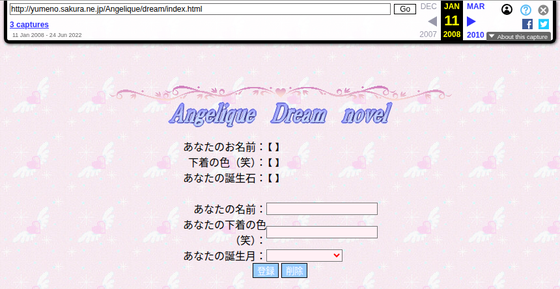
A dream novel is a way of writing: your name gets swapped into the text. Yumeshipping is a relationship: you and a character. A dream novel need not be romantic, and someone doing this in 2026 is making images rather than reading substituted prose. The word crossed into English. The form did not. The English-speaking side came together later and mostly separately, on Tumblr and then Twitter, TikTok and Pinterest, and keeps its own terms (F/O, self-ship) alongside the imported Japanese ones. [1]
Adjacent practices, and where the lines fall
Yumeshipping is one position in a crowded field. The neighbors below are distinct claims, and participants keep them apart.
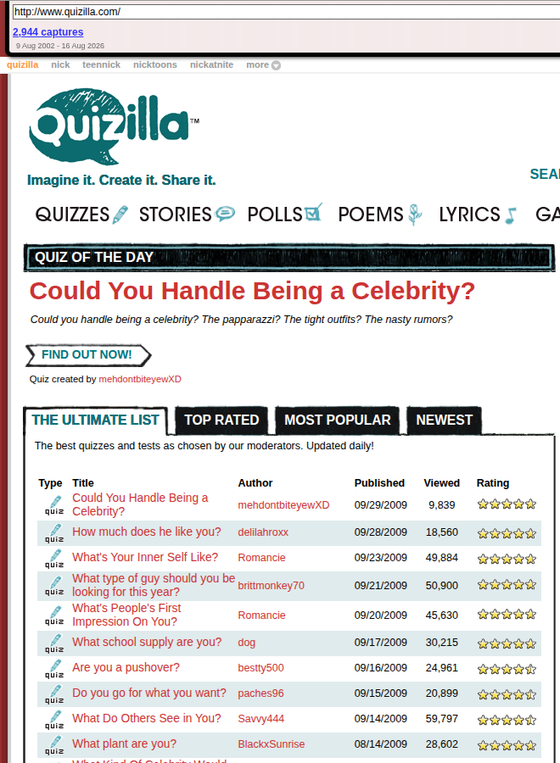
READER-INSERT. Fan fiction in the second person, filed as "Canon x Reader," in which the protagonist is whoever is reading. The English tradition runs at least to a 1999 Star Trek story on FanFiction.net and flourished on Quizilla. Fanlore treats the dream novel as its Japanese counterpart. The two reach the same effect by different means, one with second-person pronouns and the other by swapping the name in code, and neither tradition appears to have known of the other. [10]
FICTIONKIN. Identification as the character rather than with them. The distinction from self-shipping is total: one is a relationship, the other is a claim about who you are. It comes from a different line, running through elfinkind and otherkin; an early term was "Ota'kin," otaku plus otherkin, coined by Kinjou Ten in 2001 at the latest. [10]
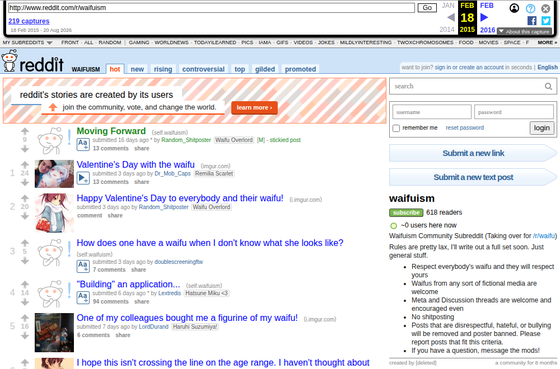
WAIFU / HUSBANDO. Strong attraction to a fictional character, usually one from anime. The word is ワイフ, a Japanese transliteration of the English "wife," adopted in the 1980s to replace 家内 (kanai), which literally means "inside the house" and drew objections for saying exactly that. It is generally traced into fandom through a line in Azumanga Daioh. The associated communities police their own boundaries: r/Waifuism, founded 2014, prohibits polyamory, original characters, and "hugblanketing," defined as casual waifuism. [10]
FICTOSEXUALITY. An orientation: exclusive attraction to fictional characters. It overlaps the self-shipping community and is not the same thing. It carries its own vocabulary, including nijikon, "2D complex," and, for everybody else, "flesh people." [10]
SNAPEWIVES. Recorded as the far end of the range. A group, mostly women, active around 2006 on LiveJournal, who held that they channeled the character Severus Snape, were in romantic relationships with him, and that the Harry Potter books existed because their author had channeled him as well. The community deleted its own pages and forums because of mockery from outside. What survives survives because others had copied it. [10]
Self-government
The main English-language gathering point is a subreddit created 27 NOV 2024, which reports 31,000 weekly visitors. It publishes fifteen rules and a long expansion of them, which opens by warning that these are rules for the subreddit and not rules for yumeshipping. [16]
Yumeshipping a real person is prohibited outright, parasocial attachment to celebrities and streamers included, because, the rule says, real people have boundaries to respect; asked where VTubers fall, the moderators put the character inside the line and the performer outside it. A nonhuman F/O must first pass the Harkness Test, which asks whether a creature is capable of consenting at all. The rules do not gloss the name; it is almost certainly Captain Jack Harkness, of Torchwood. Generated images are banned, and so is discussion of them.
The community describes itself as friendly to soulbonding, defines it in its own FAQ as communicating with an F/O in one's mind, and states that harassment of soulbonders will not be tolerated. What the 2006 group was mocked out of existence for is a category this one protects by rule.
The rules are not where the vocabulary stops. (EXHIBIT F)
| Sharing status | Named in the rules? |
|---|---|
| nonsharing (NS) | yes |
| selective-sharing | yes |
| hypersharing | no |
| mirror-sharing | no |
| fuse-non-sharing, fuse-selective | no |
| voidsharing (VS) | no |
The vocabulary problem: two names for one thing
The practice is documented under one set of names by its participants and under another by everyone else, and the two sets barely intersect.
The community's own vocabulary is at EXHIBIT B. The meme wikis, working from outside, file the same material under "Heart Locket GIF" and "My Beloved," neither of which contains a term a participant would use of themselves. [5][6] How-to videos on TikTok sit under headings that join the two sets: "Yumeship Gif Maker," "How to Make Yumeship Gifs." [7]
General reference works hold neither set. The English Wikipedia article on shipping covers the word's origins, its naming conventions, and the Japanese vocabulary of fujoshi, yaoi and seme-uke, and does not mention self-shipping, self-inserts, reader-inserts, waifu or dream novels at any point. [14]
So a person searching for the practice and a person searching for the tool may be the same person using different words, and an observer holding one set of names concludes the other population does not exist. The site held only the second set from 2008 to 2026. The encyclopedia holds neither.
A CapCut template made for the practice carries both yumeship and selfship in its address. [18] Somebody outside the site had the name right.
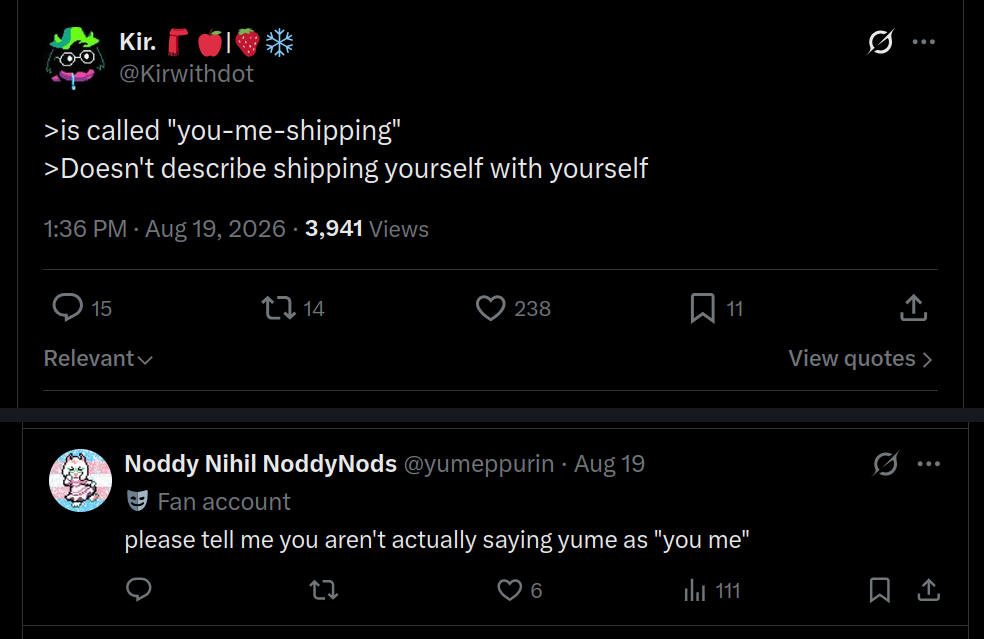
The split reaches the word itself. 夢 is yu-me, the second syllable as in "bet." A reader who has only ever seen the word written can take it for "you-me." (EXHIBIT G)
What is produced
The practice is no longer mainly about writing. Its output is images and objects, and the locket is one item among many.
Fanlore records fanart of the pair, drawn or commissioned; fanfiction pairing an F/O with a self-insert; and moodboards, calling that a sampling of a huge range. [1] Alongside those: matching icons used as profile pictures, avatars built in Picrew, a Japanese service that assembles a character from parts, and edits, meaning short videos or composites cut from source material.
There is a business alongside it, and a stranger one than that list suggests. (EXHIBIT H)
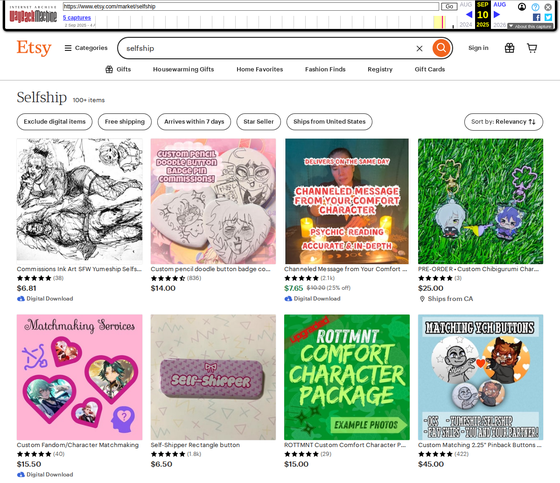
One listing on the page bears on the Snapewives entry above. A "Channeled Message from Your Comfort Character" is sold as a psychic reading, delivered the same day. The belief that the character can be reached and will answer is not confined to 2006. It is now a product with a delivery estimate.
The digital keepsake and the physical one serve the same purpose, and the physical one is older. Set against all that, the generator is one station in a production chain.
Finding: selection of the device
This population picked the locket for what it does. Any locket does it; this site happens to make one.
A locket has two chambers. Its whole function is to hold two things and assert that they belong together, and to do it privately: worn closed, opened when the owner chooses, shown or not shown.
The practice has one central problem: how do you picture a relationship where one of the two is real and the other is not? It needs a form that holds both without ranking them. The locket makes no distinction between its two sides. (EXHIBIT I)
The client has built this object five times: the heart locket itself, running since 2008; a gold variant in 2014; the "now kiss" locket and a closing locket two days apart in FEB 2022; and a further heart locket in JUN 2026. [19] The demand was obvious from 2014. Who was generating it was not established until 2026.
Appendix: notes on the record
Qualifications that belong on the file but not in the account above.
ON THE DERIVATION. That the yume in yumeshipping comes from yume shousetsu is taken from Japanese explainers of 夢女子. Neither source cited here states it directly.
ON YUMEJOSHI. The word is commonly said to have been formed in contrast to fujoshi (腐女子), the term for a fan of male-male pairings. The source consulted does not say so. Recorded as inference.
ON THE EARLY PERIOD. The Japanese Wikipedia article carries maintenance banners for original research and for lacking sources, and rules out an earlier candidate, Whistle!, on the ground that the form predates that series. It is the best available account of the period, which is not saying much. [3]
ON EXHIBIT C. The page sits in DreamMaker's own subdirectory but credits a different converter, Notepad Dream, in its footer. There was more than one tool.
ON REPRODUCTION. Everything shown here is public, credited, and linked to its source, under the handles its authors chose. The standard applied to the specimen at EXHIBIT I was that no photograph of a private person appears in it: both occupants are drawings. A locket holding somebody's face would not have been reproduced whatever its license, and the Snapewives are left unreproduced entirely, having deleted their own material to get away from this kind of attention.
ON THE FICTIONAL PARTY. One of the two occupants of every locket described here cannot consent or object. Noted only because an outside reader will reach for it; participants got there first, and formalized a test.
References
Sources are cited as consulted. Corrections, particularly to the terminology and to the account of the early Japanese period, are welcome.
- "Self-Shipping." Fanlore. (Community-maintained wiki; the principal English-language record for the terminology.)
- "Comfort Character." Know Your Meme. (Dates the term to a May 2020 Urban Dictionary entry, with spread from March 2021.)
- "ドリーム小説." Japanese Wikipedia. (Read in the original. Its 1997 Harlem Beat claim has been tagged citation-needed since 2011; see the appendix.)
- Case file ML-2020-1011: the "my beloved" heart locket meme. (The device's other case history.)
- "Heart Locket GIF." Know Your Meme.
- "My Beloved." Know Your Meme. (The format's public name.)
- "Yumeship Gif Maker" and "How to Make Yumeship Gifs." TikTok.
- DreamMaker. Distribution site for the name-conversion tool, still online. Its earliest capture, 22 MAR 2007, announces the arrival of the site's 三代目管理人, its third administrator.
- "Angelique Dream novel." Captured 11 JAN 2008; Internet Archive. (EXHIBIT C.)
- Fanlore: "Reader-Insert," "Fictionkin," "Waifu," "Fictosexuality," "Snapewives."
- "Selfship" category, Etsy. Captured 10 SEP 2025; Internet Archive. (EXHIBIT H.)
- Quizilla. Captured 30 SEP 2009; Internet Archive. The service closed in 2014. (EXHIBIT D.)
- r/Waifuism. Captured 18 FEB 2015; Internet Archive. (EXHIBIT E.)
- "Shipping (fandom)." English Wikipedia. (Origin of ship and the OED's earliest citations. Contains no mention of self-shipping, self-inserts, reader-inserts, waifu or dream novels.)
- @Kirwithdot, 19 AUG 2026, and the replies to it. X. (EXHIBIT G.)
- "r/Yumeshipping Rule Expansion and FAQ," r/yumeshipping. Consulted AUG 2026. (The subreddit's fifteen rules and the moderators' expansion of them, with the FAQ defining riako and soulbonding.)
- "Yume question #8," r/yumeshipping, AUG 2026. (Exhibits F and I, both from this thread: the flair is on its repliers, the specimen was posted by the member who opened it.)
- CapCut template whose address carries both yumeship and selfship. Consulted AUG 2026.
- The operator's own records, made available for this file. Designs enter version control on release, so the four later dates are exact; version control itself begins 5 JUL 2010, and the heart locket is already in it, so its 2008 date rests on the site's account rather than on the record.